Published: 29th October 2026
Nobody appointed you. But AI has already started changing the work, expectations and decisions you lead. The promotion happened quietly. You may have missed it.
A piece of work landed in your inbox much faster than usual.
It was polished. The argument looked sensible. Then someone mentioned they’d used AI for the first draft.
Your next thought probably wasn’t: Excellent, our AI strategy is progressing nicely.
It was something closer to: Is this right? Who checked it? Should this now take everyone less time?
And perhaps, underneath all of that: what do I expect from the person who produced it now?
That was the promotion.
When AI changes what good work looks like, how long something should take or where human judgement sits, leadership decisions follow.
Nobody updated your job description. No induction appeared in your diary.
You didn’t even get a mug.
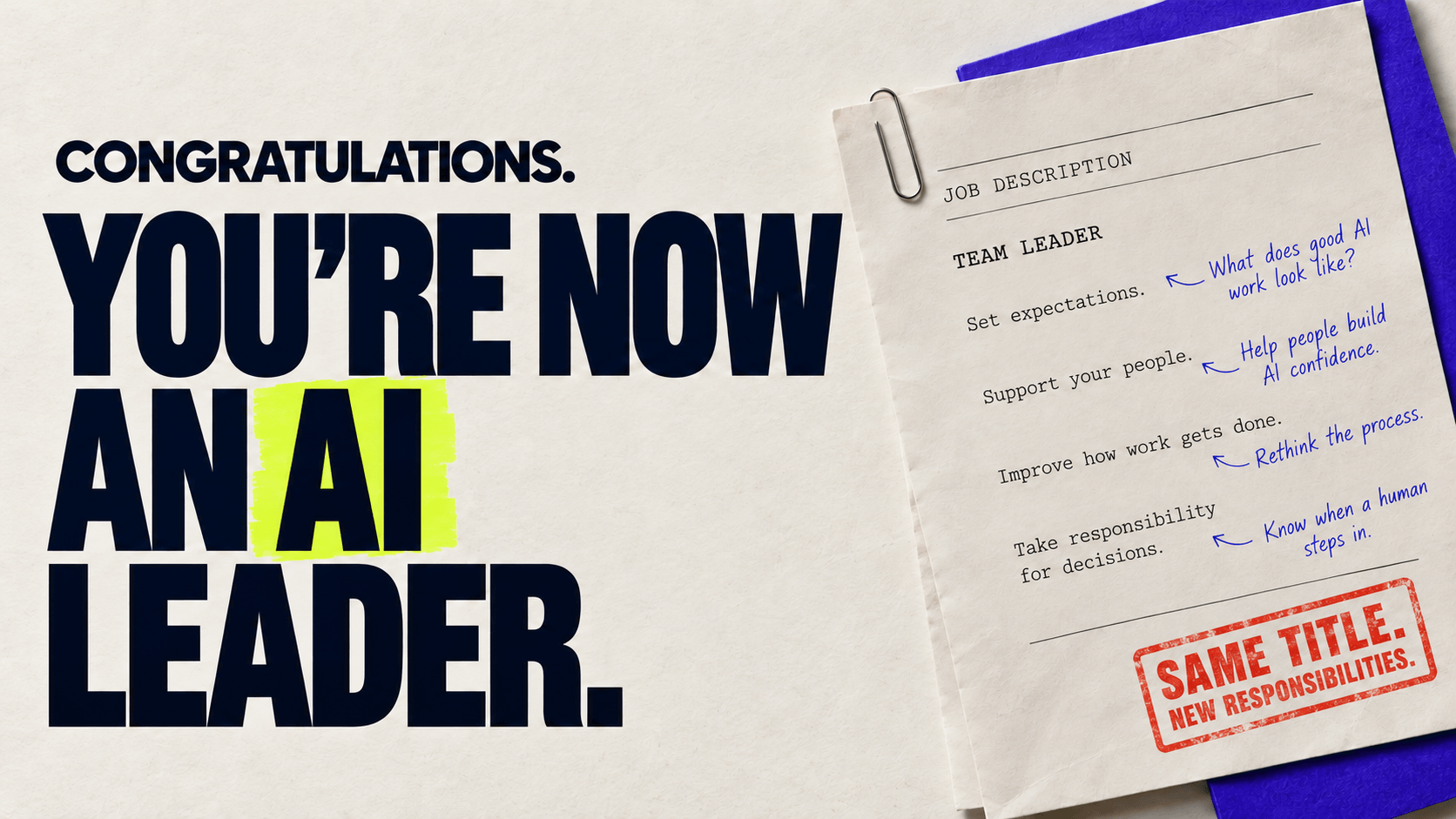
Congratulations. You’re now an AI leader.
THE WORK CHANGED FIRST
AI arrived inside ordinary tasks.
Someone used Copilot to make sense of a long document. Meeting notes appeared before everyone had left the call. A team found a quicker route through an admin-heavy process.
Small moments, until they start joining up.
For managers, each introduces questions about quality, expectations and responsibility. What should people check? What support do they need? If a task becomes faster, how should their workload change?
Those questions can arrive while an organisation is still developing its approach to AI. Leaders need enough understanding to make decisions alongside the people doing the work.
THE BLANK PAGE HAS MOVED
Think about turning a messy pile of information into something useful.
Much of the effort traditionally came before there was anything to review. Find the information. Make sense of it. Decide what matters. Work out how to explain it.
AI can produce a starting point much faster. Human effort then shifts towards deciding whether that starting point is any good.
Is it accurate? What’s missing? Does the recommendation follow from the evidence? Would you put your name underneath it?
The blank page has moved.
For some tasks, more of the human contribution goes into directing, challenging, refining and judging AI-assisted work.
That changes what managers need to recognise and support.
Someone who stood out for producing excellent first drafts may also contribute through clear instructions, careful checking and spotting weak reasoning. A polished answer can conceal a misunderstanding. A colleague who catches that misunderstanding has done valuable work.
Leaders need to make those expectations explicit. What does a good review involve? Which decisions require particular care? When should someone ask for another view?
A faster first draft gives people a different starting point. It still needs sound judgement.
A SUCCESSFUL PILOT MEETS AN ORDINARY TUESDAY
A pilot can make a new way of working look tidy.
The problem is clear. The group is small. People know they’re testing something. Everyone pays attention because somebody has put pilot in the meeting title.
Then it works.
Excellent. Now introduce it to the organisation on an ordinary Tuesday.
The process has three slightly different versions. Important information lives somewhere nobody mentioned during the workshop. Another team has a spreadsheet called FINAL_v7_USE_THIS_ONE.
Someone now needs to decide which process to follow, which information to trust and who handles exceptions.
The question has grown from whether AI can complete a task to how that task should fit into everyday work.
Imagine a process with eight steps. AI makes three much faster. Take the win, then look at the whole process again:
If we were designing this work today, would we still build it this way?
Some steps may exist because information used to be difficult to find. A handover may reflect knowledge held by one person. Those arrangements may still serve a purpose. AI gives you a reason to examine them.
That brings roles, responsibilities, skills and measures into the conversation. Technology teams contribute essential expertise. Leaders and the people doing the work help decide how the process should change.
WHEN AI STARTS ACTING
Many people first encounter workplace AI through requests: summarise this, draft a response, compare these documents.
Agents can extend that role.
An AI agent can work through a task using information and tools, within the permissions and limits set for it.
For example, an agent might retrieve information, check a system and complete an authorised step in handling an enquiry. What it can do depends on its design and access.
That introduces decisions about how much responsibility to give it.
Leaders need to work with technical and governance colleagues to ask:
- What information and systems can the agent access?
- Which actions can it take?
- Where does a person need to review or approve?
- What happens when something goes wrong?
- Who remains accountable for the result?
The level of oversight should reflect the task and its consequences. A routine internal update and a decision affecting someone’s access to a service deserve different treatment.
Understanding the capability helps leaders set appropriate boundaries.
SAME title. different job.
AI leadership draws on familiar skills: asking questions, weighing risk, setting expectations and bringing the right people together.
Those skills need enough practical AI knowledge behind them. Leaders should understand the uses being proposed, their limits and when specialist advice is needed.
A useful place to start is one task your team already uses AI for.
Ask the person doing it to walk you through what changed. Look at the output, the checks and the time involved. Discuss what good performance now looks like and where responsibility sits.
That conversation can reveal both an opportunity and a support need.
AI can reduce repetitive effort, create room for better conversations and prompt a fresh look at established processes. Leaders help decide how those possibilities become part of working life.
Your title may look exactly the same. The job underneath it is changing.
You’ve probably been doing parts of that job for some time.
You just hadn’t called it AI leadership yet.