Published: 18th November 2026
AI governance has a reputation for slowing things down. Ofgem’s experience offers an interesting challenge to that assumption.
When someone builds an AI agent that could solve a frustrating workplace problem, the next question is naturally…
“Can we get this live?”
Then come a few more.
Who approved it? What information can it access? Has anyone checked the risks? Who takes responsibility when something goes wrong?
For organisations managing sensitive information and public responsibilities, these questions carry weight.
They were central to Ofgem’s approach to AI.
During our recent AI governance webinar, Penny Holborn, Head of Data and AI Strategy and Innovation at Ofgem, joined Erica Jefferies, our AI, Data and Digital Practice Lead, to discuss their work together.
They shared how Ofgem has developed its approach to Copilot, AI agents and governance, building processes around practical experience.
And one result stood out.
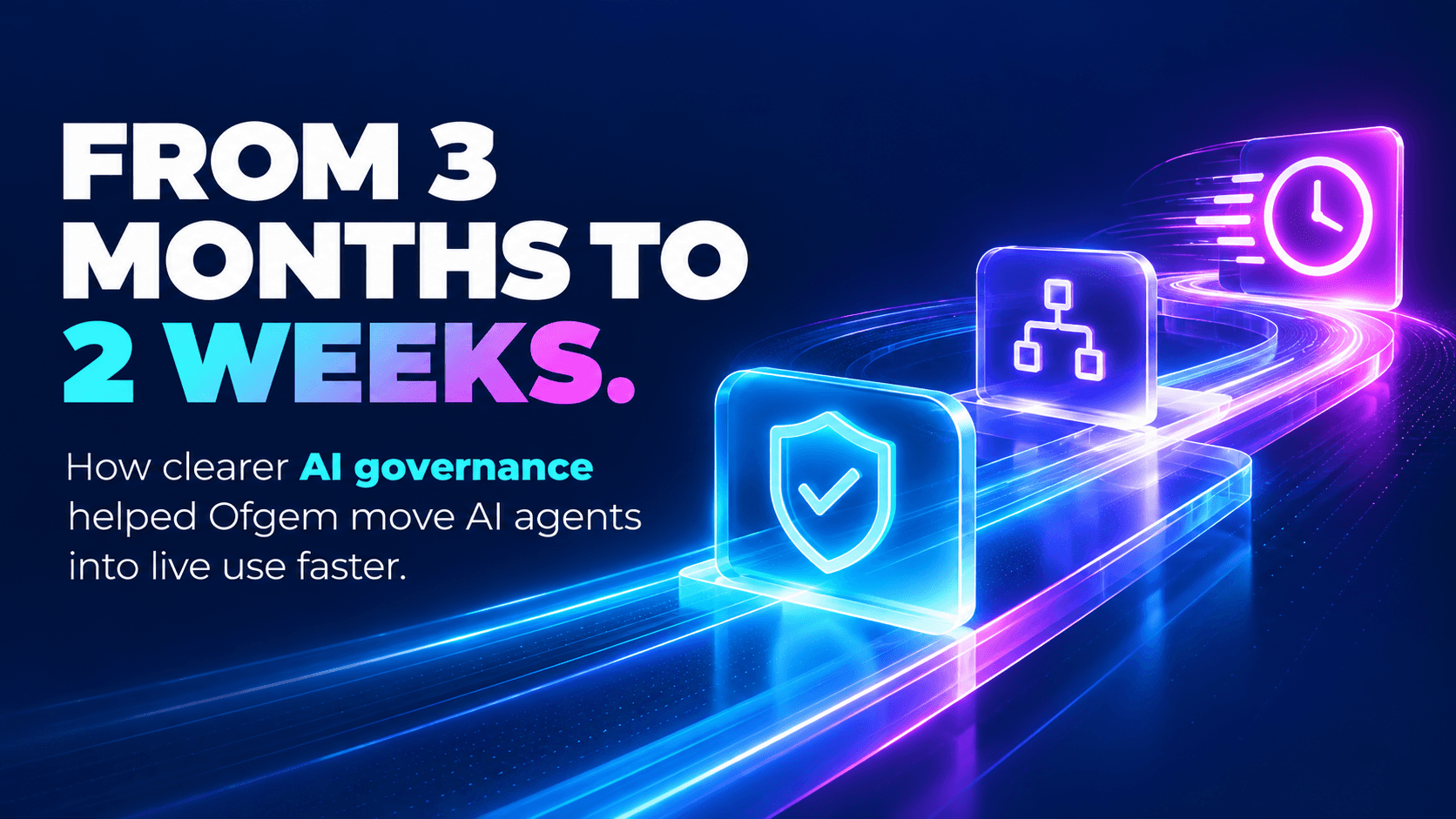
The time needed to get an agent into live use fell from nearly three months for an early agent to around two weeks once a clearer agent lifecycle was established.
Here’s what happened.
Starting small when the appetite for AI was growing
As the UK’s energy regulator, Ofgem operates in an environment where managing risk matters.
Its AI journey began with Microsoft 365 Copilot.
Employees could access premium Copilot licences after completing acceptable-use training. This gave people an opportunity to explore the technology while learning how to use it responsibly.
As people grew more comfortable using Copilot, their ideas grew too.
Teams started asking about AI agents and what they could build using Copilot Studio.
Ofgem wanted to support that enthusiasm while maintaining appropriate control over what reached the wider organisation.
So the team began with small, low-risk pilots, using practical experience to develop the governance needed for wider use.
AI made an old SharePoint problem harder to ignore
One of the webinar’s most relatable moments involved SharePoint.
More specifically, what happens when years of documents, policies and permissions accumulate across an organisation.
Erica reflected on the prospect of asking someone to review 2,000 SharePoint sites.
It’s hardly the sort of task people rush to volunteer for.
But AI gave that work new urgency.
Copilot can draw on organisational information to support people’s work. That makes outdated documents, duplicate policies and unclear access permissions increasingly important.
An old policy sitting forgotten in SharePoint can suddenly find its way into an AI-generated answer.
At Ofgem, reviewing the information environment exposed redundant sites, duplicate content and areas where data ownership needed attention.
It became a substantial piece of work, with clearer ownership and actions for addressing the findings.
AI had given Ofgem a compelling reason to tackle information problems that already existed.
For organisations expanding Copilot, the lesson is worth remembering: understanding your information, its quality and who can access it is part of preparing for AI.
Building the guardrails alongside the agents
As interest in Copilot Studio grew, Ofgem worked with The Inform Team to run practical agent-building sessions.
Around 25 colleagues took part across sessions in Glasgow and London.
Many were new to Copilot Studio. They were learning how to turn useful ideas into working agents.
But creating an agent and releasing it into everyday use are different things.
Ofgem needed to understand what checks, approvals and responsibilities should sit between those two stages.
The team chose low-risk use cases and developed its governance approach alongside the sessions.
Each pilot helped answer practical questions.
Was an agent the right solution? What information would it need? Who should approve its design? What testing would be required before release?
During the webinar, Erica recalled the pace of those early preparations. The guardrails were being put in place just before the first design session.
It was a learning process for everyone involved.
The pilots gave Ofgem a way to develop governance around the work people wanted to do.
How clearer governance helped speed up deployment
An early Ofgem agent took nearly three months to reach live use.
According to Erica, the agent itself was relatively straightforward. Progress through the governance process was the challenge.
That experience helped shape a more structured approach.
Ofgem developed an agent lifecycle covering the journey from the initial idea through to design, development, testing, approval and deployment.
An agent register records the relevant information, assessments and sign-offs.
The process also brings governance, security, data and technology teams into decisions throughout development.
With that lifecycle established, Erica reported that deployment time had fallen to around two weeks.
It’s an interesting result.
The checks were still there. Teams now had a clearer route through them.
People understood what information was needed, who should be involved and what had to happen before an agent could move forward.
For organisations under pressure to deliver AI projects, that offers a useful perspective.
Putting time into governance early can make later decisions easier and give teams more confidence about moving into live use.
Before building an agent, Ofgem asks an important question
Ofgem established an AI Centre of Excellence, bringing together colleagues from governance, security, data, technology and communications.
The group supports decisions throughout the agent lifecycle.
And one of its responsibilities begins before development starts.
Should this agent be built?
When people are enthusiastic about the technology, it’s tempting to move straight from a good idea into development.
Ofgem looks at the value, feasibility and ongoing responsibilities first.
Could better guidance solve the problem? Would an existing tool be more suitable? Will the benefit justify the effort involved in building, maintaining and monitoring an agent?
These questions matter because an agent needs attention after launch.
Someone must remain responsible for its performance, permissions, monitoring and ongoing value.
The Centre of Excellence gives Ofgem a way to make those decisions collaboratively, with plans to extend its oversight to other AI tools and programmes.
What other organisations can learn
Ofgem’s experience offers practical lessons for organisations working through similar challenges.
Start with manageable use cases. Low-risk pilots create opportunities to learn, test assumptions and develop controls before wider deployment.
Understand the information AI will use. Outdated documents, duplicate content and unclear permissions deserve attention as AI becomes part of everyday work.
Build governance into delivery. Bring the people responsible for security, data, technology and business outcomes into the process early. Give them a clear way to make decisions together.
Consider the full life of an agent. Assess its value before development and establish ownership for what happens after deployment.
Allow the approach to develop. Technology, organisational needs and governance requirements will continue to change. Regular review helps the organisation respond.
A foundation for the next stage
At the time of the webinar, Penny reported that Ofgem had around ten agents live, with approximately 25 more in its backlog or moving through development.
She also shared that around 90% of the organisation held premium Copilot licences, with formal training required before access.
Ofgem is now developing its approach to ongoing agent monitoring and exploring how to make agent-building capabilities available more widely.
The journey continues, but the organisation has established a foundation it can build on.
Its experience shows what can happen when governance develops alongside practical use, supported by clear ownership and shared decisions.
For organisations feeling pressure to move faster with AI, taking time to establish a clear route forward is time well spent.
Where is your organisation on its AI governance journey?
At The Inform Team, we work with organisations to connect AI strategy, readiness, governance and adoption.
We help teams understand their current position, establish practical controls and build the confidence to introduce AI responsibly.
Whether you’re exploring your first use cases or preparing to scale agents, we can help identify a sensible next step.